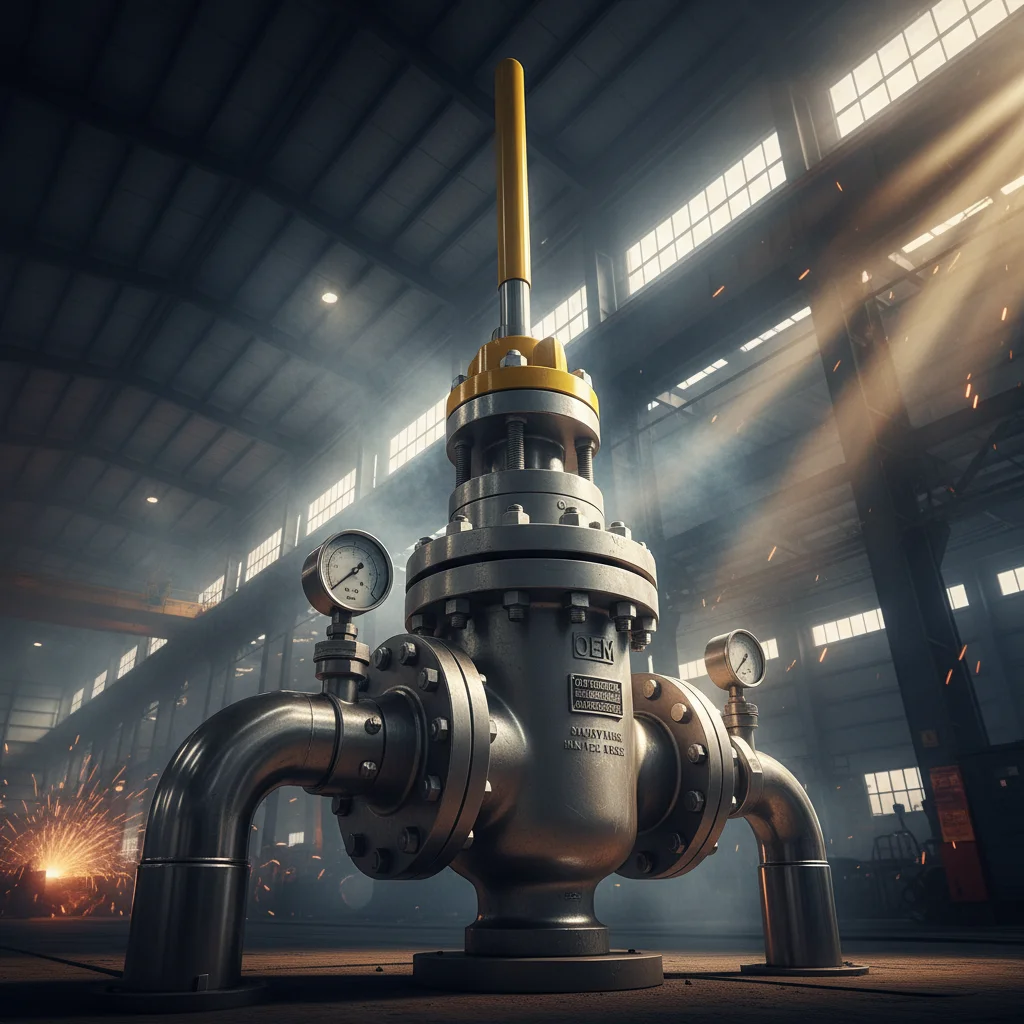
In high-pressure oilfield environments, the margin for error is practically zero. The deployment of a certified OEM security valve serves as the final line of defense against catastrophic overpressure events that can lead to blowouts or systemic pipeline failure.
Selecting the correct pressure relief mechanism requires more than just matching a PSI rating; it demands an understanding of fluid dynamics, corrosive medium compatibility, and strict adherence to API standards. For operators managing drilling rig manifold assemblies, the difference between a generic valve and an engineered OEM solution often dictates the long-term ROI of the asset.
This technical analysis explores the critical selection criteria and performance benchmarks for safety valves used in oil and gas extraction, focusing on how specialized designs mitigate risks in extreme temperature and corrosive conditions.

Engineering Fundamentals of High-Pressure Safety Valves

The primary function of an OEM security valve in a petroleum context is to provide instantaneous pressure relief when system limits are exceeded. Unlike standard industrial valves, oilfield-grade safety valves must operate reliably under fluctuating back pressures and in the presence of abrasive particulates common in drilling muds and crude oil.
Structurally, these valves range from weighted lever designs for lower-precision needs to sophisticated pilot-operated systems for high-accuracy requirements. The mechanism must ensure a "full-lift" or "micro-lift" action depending on whether the medium is gas or liquid, preventing the valve from "chattering," which can lead to premature seat wear and leakage.
Furthermore, the integration of these valves into wider systems—such as those involving API Flanges and Rotary Drilling Hoses—requires precise dimensional compatibility to ensure that the safety assembly does not become a point of mechanical weakness under extreme vibration.
Critical Technical Specifications for Oilfield API Standards
Adherence to API specifications is not merely a regulatory requirement but a technical necessity for interoperability and safety. A high-performance safety valve must exhibit extreme stability in its opening pressure, ensuring that it triggers exactly at the designated set point to protect downstream manifolds.
One of the most critical technical features is the inclusion of radiators for high-temperature applications. When operating temperatures exceed 300°C for closed valves or 350°C for open ones, heat transfer to the spring chamber can cause spring fatigue and shift the opening pressure, leading to dangerous delays in relief.
Additionally, for corrosive media, bellows-sealed designs are employed to isolate the internal spring from the process fluid. This prevents corrosion-induced failure and ensures that the valve remains operational even when handling aggressive gases or saline-heavy liquids.
Application Scenarios in Drilling and Production Systems
The application of safety valves varies significantly depending on the specific segment of the oilfield operation. In oil well outlets, pilot-operated safety valves are preferred due to their superior accuracy and stability under the high-pressure fluctuations typical of the wellhead.
For LPG tank trucks and storage, full-lift internal safety valves are utilized to provide rapid venting of flammable gases. In these scenarios, the valve must not only relieve pressure but do so without creating hazardous leaks that could ignite in the surrounding atmosphere.
Conversely, in power generation bypass equipment, dual safety and control pilot-operated valves are used to manage both the pressure relief and the flow control, ensuring that the system maintains equilibrium without unnecessary downtime during pressure spikes.
Benchmarking Valve Response and Reliability Metrics
When evaluating the efficiency of an OEM security valve, engineers look at the ratio of response time to pressure surge. A high-quality API-grade valve minimizes the "overshoot"—the amount by which the pressure exceeds the set point before the valve fully opens.
Reliability is further measured by the valve's ability to reseat perfectly after a discharge event. Poor reseating leads to "simmering," where the valve leaks slightly, causing loss of product and potential environmental hazards.
OEM security valve Performance Metrics
As shown in the performance comparison, valves engineered for API oilfield standards typically exhibit significantly lower failure rates and higher temperature stability compared to general industrial safety valves, primarily due to the use of specialized alloys and thermal protection.
Procurement Strategies for High-Hazard Environments
Procuring safety valves for critical infrastructure requires a shift from "lowest cost" to "lowest total cost of ownership." The cost of a single failure in an oilfield manifold far outweighs the initial investment in a premium OEM valve.
Key procurement indicators include the availability of lifting wrench options for periodic flexibility checks. Being able to verify valve operation at 75% of the opening pressure without fully shutting down the system significantly reduces maintenance downtime.
Buyers should also verify the manufacturer's testing protocols. Rigorous pressure testing and material certification (such as Mill Test Reports) are essential to ensure the valve can withstand the actual operating pressures of the drilling rig manifold.
Innovations in Thermal Stability and Material Science
The evolution of safety valves is currently driven by the need to operate in deeper, hotter wells. New materials, including advanced nickel-based alloys and specialized coatings, are being integrated to combat the synergistic effects of high pressure and corrosive H2S gas.
Smart monitoring is another emerging trend, where sensors may be integrated into the valve body to provide real-time data on discharge events. This allows operators to identify pressure surges immediately rather than relying on manual inspections or post-event analysis.
Furthermore, the move toward more modular designs allows for easier replacement of internal components, such as springs and seats, without requiring the removal of the entire valve assembly from the pipeline, thereby enhancing operational efficiency.
Comparative Selection Guide for Various Media Types
Choosing the wrong valve type for a specific medium can lead to immediate failure or accelerated wear. For example, using a standard spring valve for highly corrosive fluids will result in spring fatigue and a shift in set pressure within weeks.
The following table provides a decision matrix for selecting the appropriate valve configuration based on the medium and the operational environment.
| Medium Type | Recommended Series | Key Feature | Primary Risk Mitigated |
|---|---|---|---|
| High-Pressure Steam | Full-lift Spring (0490) | Integrated Radiator | Thermal Spring Fatigue |
| Oilfield Liquids | Micro-lift Spring (0485) | Precision Relief | Excessive Fluid Loss |
| Corrosive Gases | Bellows-Sealed Design | Internal Isolation | Material Degradation |
| Wellhead Outlets | Pilot-Operated Valve | High Stability | Pressure Fluctuations |
| LPG Tank Trucks | Full-lift Internal | Rapid Venting | Tank Overpressurization |
| Bypass Systems | Dual Pilot Control | Flow Modulation | System Imbalance |
Ultimately, the selection should be validated by the system's total pressure profile and the chemical composition of the transported medium. For those evaluating high-pressure components, detailed technical support and custom engineering are available through www.hrzzparts.com.
Frequently Asked Questions
Conclusion
The integrity of high-pressure oilfield operations depends on the reliability of overpressure protection. An engineered OEM security valve is not just a component but a critical safety asset that ensures the protection of personnel, equipment, and the environment.
By focusing on API compliance, thermal stability, and medium-specific design, operators can significantly reduce the risk of failure and improve the overall ROI of their drilling and production assets. For professionals seeking certified pressure relief solutions, further technical specifications can be found at www.hrzzparts.com.