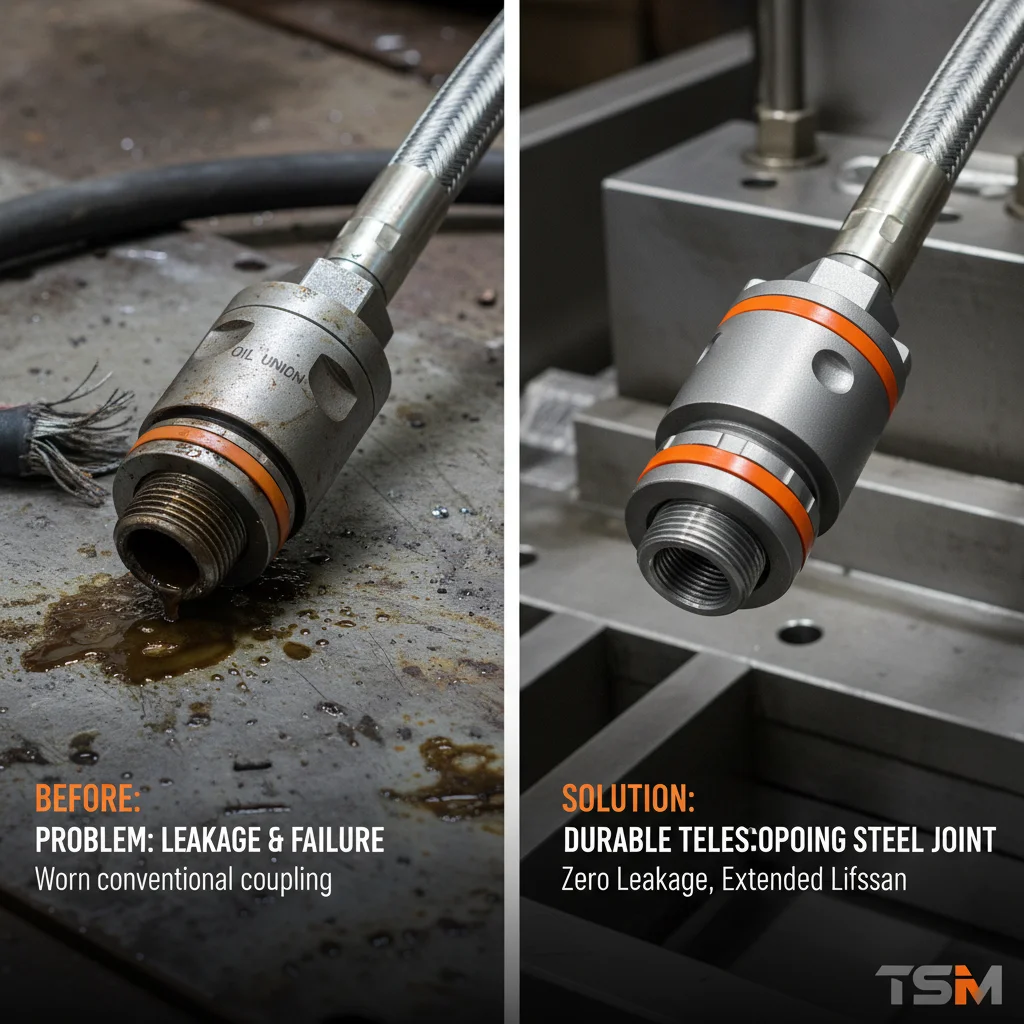
Managing large-diameter pipeline connections in oilfield environments often presents a recurring challenge: the struggle between maintaining a leak-proof seal and the reality of imperfect site alignment. When mud tanks shift or installations are rushed, rigid couplings frequently fail or require exhaustive manual adjustment.
The shift toward adaptive coupling technologies is driven by the need to reduce downtime during well construction. In the solids control system, where drilling fluids like mud, oil, and water are transported, the ability to accommodate spatial deviations without compromising seal integrity is a critical operational requirement.
Selecting a qualified high-pressure Pipe Fitting Joint Manufacturer requires an understanding of how specific sealing mechanisms—such as pneumatic tire technology—solve the problems of misalignment and frequent disassembly in demanding petroleum applications.

The Logic of Adaptive Coupling

Traditional rigid unions rely on precise axial alignment to achieve a seal. In the field, however, mud tanks and pipeline segments rarely align perfectly. This discrepancy creates stress on the joints, leading to leaks or installation delays.
The transition to adaptive coupling, specifically the use of pneumatic tire elements within a carbon steel shell, allows the joint to "absorb" misalignment. By replacing a rigid gasket with a compressed air-filled tire, the joint can maintain a seal even when the relative positions of the connected tanks shift.
Technical Anatomy of Pneumatic Sealing
The core of this technology is the synergy between a durable carbon steel casting shell and a specialized pneumatic tire sealing element. The shell provides the structural integrity necessary to withstand the environment, while the tire element creates a dynamic seal. Unlike static seals, the pneumatic tire can deform to fit the irregularities of the mating surface, ensuring a leak-proof interface.
From a technical standpoint, the maximum working pressure is rated at 0.4 Mpa, making it ideal for low-pressure, large-diameter applications. The recovery time—the speed at which the tire returns to its original shape after deflation—is typically between 1 to 3 seconds, which is vital for rapid reconnection cycles during site reorganization.
Material compatibility is another critical factor. The union is engineered to handle a wide spectrum of drilling fluids, including oil, clean water, and both acidic and basic muds. This chemical versatility ensures that the sealing element does not degrade prematurely when exposed to corrosive additives common in modern drilling fluids.
Operational Impact on Well Construction
The implementation of quick-connect pneumatic unions directly affects the timeline of well construction. In the solids control system, where mud tanks are frequently repositioned or added, the time spent on manual pipe fitting can accumulate into significant delays.
By eliminating the requirement for precise axial alignment, pneumatic tyre unions reduce the physical labor of field personnel and accelerate the assembly of large-diameter mud transport systems, directly shortening the overall construction period.
Beyond speed, the reduction in manual labor reduces the risk of worker injury associated with forcing heavy, misaligned pipes into place. The system's ability to interface seamlessly with both glass steel pipes and flexible hoses further enhances the agility of the site layout.
Performance Benchmarking
Evaluating the efficiency of a coupling system involves measuring several key performance indicators: installation speed, misalignment tolerance, and sealing reliability. While standard rigid unions offer high pressure ratings, they perform poorly in scenarios requiring frequent movement or imperfect alignment.
The following index illustrates the relative performance of pneumatic tyre unions compared to standard rigid unions across five critical operational metrics. This framework helps operators understand where the investment in adaptive technology yields the highest return in terms of labor and time.
Figure 2. Relative Efficiency Index: Rigid vs. Pneumatic Unions
Application Scenarios in Solids Control
In a typical industrial setting, such as a mud tank farm, the pneumatic tyre union is deployed at the connection points between the primary mud tank and the shale shakers or desanders. Because these components are often modular and may be adjusted based on the site's topography, the union's high misalignment tolerance is indispensable.
Furthermore, when integrating corrosion-resistant glass steel pipes for transporting aggressive chemical muds, the pneumatic seal provides a secure interface that does not rely on tight mechanical threading, which could potentially crack the glass steel surface. This makes it a preferred choice for hazardous fluid transport in low-pressure environments.
Evolution of Drilling Fluid Interfaces
The industry is moving away from "one-size-fits-all" rigid piping toward modular, flexible architectures. This shift is driven by the need for faster rig-up and rig-down times. The integration of high-strength carbon steel with flexible sealing elements represents a middle ground between the rigidity of traditional flanges and the fragility of simple hoses.
Future challenges involve improving the lifecycle of the pneumatic element. Current maintenance cycles rely on automated alerts for inspection and replacement. As materials science advances, the goal is to develop sealing elements that offer even higher chemical resistance while maintaining the 1-3 second recovery time.
For companies like Hebei Hongru Petroleum Machinery Co., Ltd., the focus remains on adhering to API standards while optimizing the weight-to-strength ratio of the casting shells, ensuring that these unions remain durable under the most extreme field conditions.
Selection Framework for Pipeline Unions
When deciding between a standard rigid union and a pneumatic tyre union, the primary decision driver should be the frequency of disassembly and the expected level of alignment precision. If the pipeline is permanent and perfectly aligned, a rigid union is sufficient. However, for mud tank systems, the adaptive nature of the pneumatic union is superior.
Technical trade-offs must be considered. Pneumatic unions are limited to lower pressure ranges (e.g., 0.4 Mpa), whereas high-pressure API unions can handle significantly more. Therefore, these should never be used in high-pressure manifold assemblies but are the optimal choice for low-pressure transport.
The following table provides a comparison framework to assist engineers in selecting the appropriate coupling based on specific operational requirements.
| Evaluation Factor | Standard Rigid Union | Pneumatic Tyre Union | Operational Impact |
|---|---|---|---|
| Installation Time | High (Manual Alignment) | Ultra-Low (Quick Connect) | Accelerates Rig-up |
| Alignment Tolerance | Negligible | High (Adaptive Seal) | Prevents Joint Stress |
| Labor Requirement | High Effort | Low Effort | Reduces Man-hours |
| Sealing Mechanism | Gasket Dependent | Pneumatic Compression | Leak-proof Versatility |
| Pressure Suitability | High Pressure | Low Pressure (0.4Mpa) | Application Specific |
| Pipe Compatibility | Steel Only | Steel / Glass Steel / Hose | Material Flexibility |
Questions & Answers
It is primarily utilized for low-pressure, large-diameter connections between mud tanks within drilling solids control systems. These environments are characterized by frequent disassembly and significant pipeline misalignment, making adaptive couplings essential for maintaining leak-proof transport of drilling fluids.
Yes, the pneumatic tyre union is specifically engineered to be compatible with various media, including oil, clean water, and muds containing acidic or basic chemical additives. The sealing element is designed to resist degradation when exposed to these common drilling fluid components.
The maximum sealing pressure (the fluid pressure within the pipeline) for this low-pressure model is 0.4 Mpa. It is intended for fluid transport rather than high-pressure injection or manifold applications.
The pneumatic tire sealing element typically recovers its original shape within 1 to 3 seconds after deflation. This rapid recovery allows field operators to quickly disconnect and reconnect pipelines without waiting for the seal to reset.
The union is compatible with a variety of piping materials, including corrosion-resistant glass steel pipes and flexible hoses with integrated joints. This compatibility ensures that the solids control system can be customized for both corrosion resistance and bending capability.
By enabling quick installation and accommodating significant misalignment, the union eliminates the need for precise pipe fitting and extensive manual adjustment. This reduces the man-hours required to assemble mud tank systems, thereby accelerating the general timeline of well construction.
Final Thoughts
The transition toward adaptive coupling solutions like the pneumatic tyre union reflects a broader industry trend of prioritizing operational agility and labor efficiency. By solving the fundamental problem of pipeline misalignment in low-pressure systems, these components eliminate a significant bottleneck in solids control assembly.
For operators and engineers, the choice between rigid and adaptive joints should be based on a clear analysis of pressure requirements and site flexibility. When the goal is to minimize downtime and reduce physical labor during rig-up, pneumatic technology provides a reliable, API-compliant interface for the most demanding petroleum environments.